
What AI Taught Me This Year: Lessons, Opportunities, and Warnings for Education in 2026
By the end of last year, one thing became very clear: Artificial Intelligence is no longer a future concept in education — it is the present reality.
Since the public release of generative AI tools a few years ago, each year has brought new breakthroughs. But this year felt different. AI stopped being a novelty and became a daily companion for students, teachers, creators, businesses, and institutions.
Educational institutions are no longer asking “Should we use AI?”
They are now asking “How do we survive, adapt, and thrive with AI?”
As someone deeply interested in education, technology, and digital growth, here are the most important lessons I learned about AI this year, along with what I believe lies ahead.
1. AI Writing Is No Longer Just a Classroom Problem
Initially, AI-generated writing was seen as a challenge for teachers trying to prevent cheating. This year, it became obvious that the issue is much bigger.
AI-generated content is now everywhere:
- Social media captions that feel robotic
- Blog posts with no original thought
- Emails, cover letters, and even personal messages written by AI
- Fake videos, manipulated voices, and misleading viral content
This flood of low-quality, automated content has taught us a powerful lesson:
Authenticity is becoming rare — and therefore valuable.
The problem is no longer just academic dishonesty. It is about trust in communication, creativity, and human expression.
As a society, we must begin to value:
- Original thinking over speed
- Human voice over perfect grammar
- Transparency over automation
In the coming year, we will likely see stronger cultural and institutional pushback against careless AI use. The goal is not to reject AI, but to use it responsibly and ethically.
2. AI Tutors Are Getting Surprisingly Good
One of the most exciting developments this year was the improvement of AI-powered learning assistants.
Modern AI tutors are being designed to:
- Guide students instead of giving answers
- Ask probing questions
- Encourage critical thinking
- Adapt explanations to individual learning styles
This is especially promising for regions with limited access to teachers, tutors, or learning materials.
Imagine a student:
- Learning mathematics late at night
- Practicing coding without a mentor
- Exploring a new subject independently
AI tutors can help bridge learning gaps — if used correctly.
However, these tools still need proper evaluation. Just because technology can teach does not mean it always teaches well. Human educators remain essential for mentorship, values, and emotional intelligence.
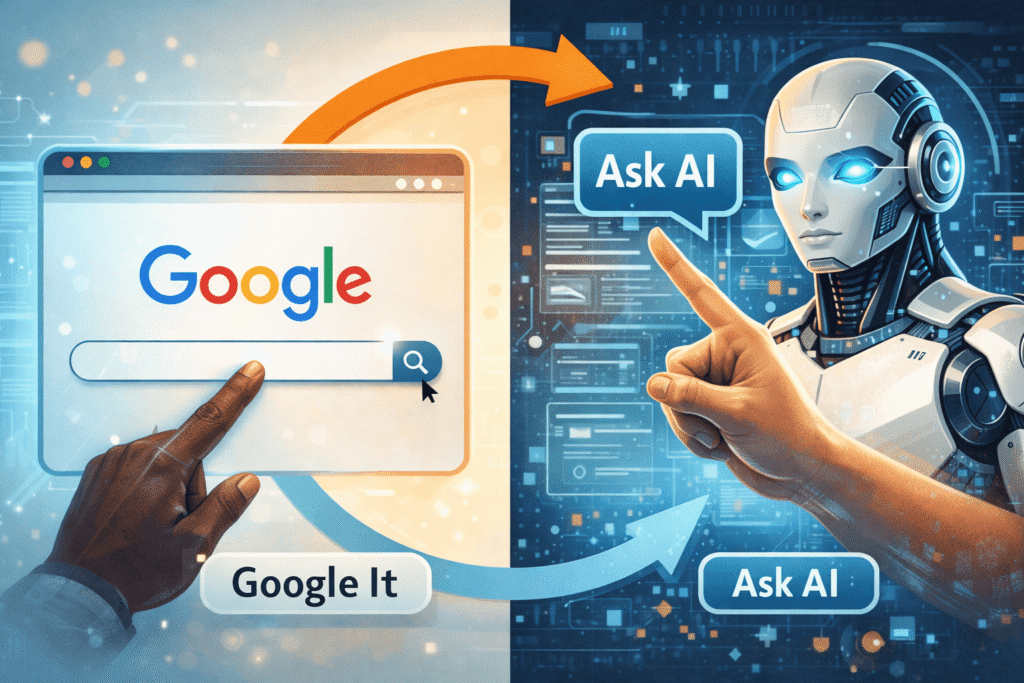
3. “Ask AI” Is the New “Google It”
One of the most noticeable changes this year is how we search for information.
For decades, “Google it” was the default response to curiosity. Today, many people — especially students and young professionals — instinctively ask AI first.
Instead of typing keywords into a search engine, users now ask full questions like:
- “Find recent research on online learning effectiveness.”
- “Explain blockchain to a beginner using simple examples.”
- “Give me teaching resources for secondary school grammar lessons.”
The advantage?
AI understands context, intent, and language, not just keywords.
However, this shift comes with an important lesson:
AI is a guide, not a final authority.
AI-generated summaries can be shallow, outdated, or oversimplified. The real value lies in using AI as a research assistant — a tool that points you toward credible sources, ideas, and perspectives that you must still verify.
Digital literacy now means knowing when to trust AI and when to question it.
4. AI Detection Tools Are Neither Villains nor Saviors
Many educators are divided on AI detection tools. Some trust them blindly; others reject them completely.
Both extremes are dangerous.
This year revealed a critical truth:
AI detection tools are imperfect — but ignoring them entirely is also a mistake.
Some tools are unreliable and prone to false accusations. Others, when used carefully, can help flag suspicious patterns. The real issue is how they are used.
Detection tools should:
- Never be the sole evidence against a student
- Be used transparently
- Be combined with human judgment, writing history, and student engagement
The future of AI detection in education lies in fair policies, clear communication, and ethical use, not blind faith or total rejection.
5. Education Is Still Catching Up — Slowly
Perhaps the most worrying lesson this year is how slow institutional change can be.
Despite years of exposure to AI, many educational systems still:
- Lack clear AI policies
- Confuse learning support with cheating
- Fail to train teachers adequately
- React instead of planning
AI is advancing rapidly, but education often moves cautiously — sometimes too cautiously.
The real danger is not AI itself, but unprepared systems. If institutions fail to act decisively, they risk losing control of assessment standards, academic integrity, and learning quality.
6. A New Skill Is Emerging: AI Literacy
Beyond reading, writing, and digital skills, this year made one thing obvious:
AI literacy is now essential.
AI literacy includes:
- Knowing how AI works (at a basic level)
- Understanding its limitations and biases
- Using it ethically and creatively
- Knowing when not to use it
Students who master this skill will not just survive the AI era — they will lead it.
Final Thoughts: The Choice Is Ours
AI is not here to replace education.
It is here to challenge, transform, and expose its weaknesses.
The question is no longer whether AI belongs in education.
The real question is:
Will we shape AI with human values — or allow it to shape us without them?
As we move into the coming year, educators, students, parents, and policymakers must work together. The goal is not to fight AI, but to ensure that human creativity, critical thinking, and authenticity remain at the center of learning.
The future of education depends on it.