
Apple’s “Awe-Dropping” Event: Five Big Themes Beyond the Gadgets
Walking onto Apple’s campus for a live event feels like stepping into a meticulously engineered alternate universe. Having attended several events at Apple’s iconic “Spaceship” headquarters in Cupertino, I should be used to it by now. Still, the effect never quite fades.
The buildings shine, the landscaping looks as if it were designed for a blockbuster film set, and most striking of all, lines of young Apple employees welcome you with relentless cheer. “Have a wonderful day!” one says. “We’re excited to have you here today!” another adds.
At first, it feels warm and inviting, like entering a tech utopia. By the fiftieth greeting, though, the charm begins to blur into something stranger. You almost expect Yul Brynner to stroll by in a cowboy hat. The experience edges into Michael Crichton’s Westworld territory: flawless, controlled, and faintly unsettling.
Apple’s “Awe Dropping” event carried much of that same energy. It was polished and precise, occasionally predictable, yet punctuated by moments of real substance. The iPhone Air, billed as the thinnest iPhone ever, dominated the headlines. But focusing solely on the hardware misses the larger message. Apple was quietly signaling its long-term direction on strategy, supply chains, design philosophy, artificial intelligence, and health. Those signals matter just as much as any spec sheet.
Here are the five themes that stood out beyond the product announcements themselves.
Apple’s Growing Modem Independence
For years, Apple has relied on Qualcomm for its 5G modems, even after public legal disputes and uneasy compromises. At the Awe Dropping event, however, Apple revealed iPhones powered by a modem designed in-house. That alone hints at a future where Apple may eventually cut Qualcomm out of the equation.
What many consumers overlook is the trade-off Apple is likely making. Its first-generation modem may not yet rival Qualcomm’s top chips in raw performance. Independent benchmarks in the weeks ahead will show whether it struggles in weak signal areas or high-speed scenarios.
But Apple has never chased specs for their own sake. Control has always been the priority. Owning a critical component like the modem allows Apple to tightly integrate hardware, software, and services, which remains its core strategy.
Put simply, Apple does not just want a modem. It wants its modem. Analysts point out that this control gives Apple greater freedom to tailor networking features to future goals, whether that means better battery efficiency, custom AI processing, or support for next-generation connectivity.
It is a risky move, and the first version may not be perfect. Still, the direction is unmistakable. Independence from Qualcomm is no longer speculation. It is actively underway.
Innovation Chips and the iPhone Air Design
The undeniable centerpiece of the event was the iPhone Air. Measuring just 5.6 millimeters thick and wrapped in polished, highly durable titanium, it immediately drew attention. Apple has long understood how powerful design can be in driving upgrades, and the Air proves the company still knows how to make a visual statement.
Some analysts called it the most dramatic design shift since the Pro lineup debuted in 2019. But the Air’s ultra-thin profile is about more than aesthetics. It points to Apple’s broader vision: devices that are thinner, lighter, and more refined. Possibly even foldable in the future.
Industry watchers often note that you have to master thin designs before you can move to foldable ones. Apple may not be ready to unveil a foldable iPhone yet, but the Air suggests the groundwork is already being laid.
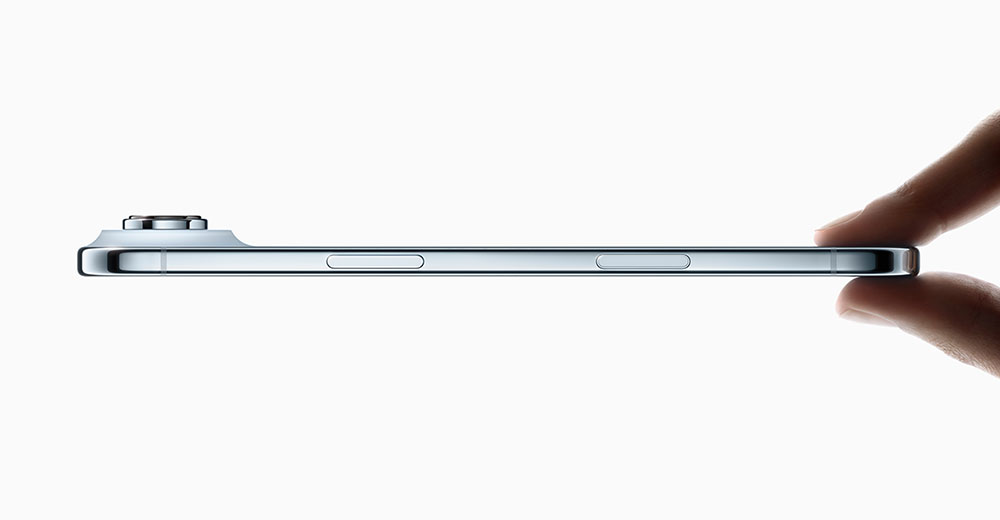
Image Credit: Apple
What makes the Air notable is that it isn’t compromised. The A19 Pro chip inside offers near-MacBook levels of computing power. The camera system remains powerful. Battery life holds up. Critics can point out that titanium, while strong, is brittle. Still, for most users, the Air demonstrates that Apple can slim down without stripping out capability.
That matters.
Apple’s innovation chips aren’t just silicon: they’re industrial design bets. The Air is a reminder that Apple’s brand still rests on devices that feel different in your hand. For consumers tired of incremental updates, that differentiation could be the nudge they need to upgrade.
Supply Chains, Pricing, and the Tariff Question
In today’s geopolitical climate, tariffs and supply chain constraints loom over every tech launch. Many expected Apple to push prices upward, citing inflation and component costs quietly. But for the most part, it didn’t. The Air came in at $999, with other models holding steady in familiar brackets.
That restraint is revealing.
Apple appears confident it can offset potential cost pressures by reworking its supply chain. The company has spent years diversifying beyond China, shifting production into India and Vietnam. By broadening its base, Apple gives itself wiggle room to absorb tariff hits without startling customers at checkout.
Most of my industry analyst peers see this as a show of confidence. Apple isn’t just weathering global trade politics — it’s mastering them. Holding the line on pricing tells customers, “We’ve got this under control.” It also suggests Apple is betting on volume this holiday season. Instead of grabbing extra dollars per device, it wants to move more devices overall.
That strategy builds loyalty.
Consumers already expect Apple products to cost more than competitors. What they don’t expect — or tolerate — are unpredictable price jumps. By keeping pricing consistent, Apple sends a message of stability in an unstable world.
Practical AI With Center Stage
Artificial intelligence is this year’s tech buzzword, and Apple gave it plenty of oxygen in June at WWDC. At this month’s event, AI took a back seat, but it wasn’t entirely absent. The most notable new feature was Center Stage, which keeps you perfectly framed on video calls.
On paper, that might sound small compared to generative models and multimodal assistants. In practice, it’s classic Apple. Rather than hyping AI with abstract promises, Apple shows it solving a simple, relatable problem. You move around during a call, and the camera keeps you centered — no fiddling, no tech jargon, just a smoother experience.