
Gemini 3: How Google’s Latest AI Model Is Shaping the Future of Learning
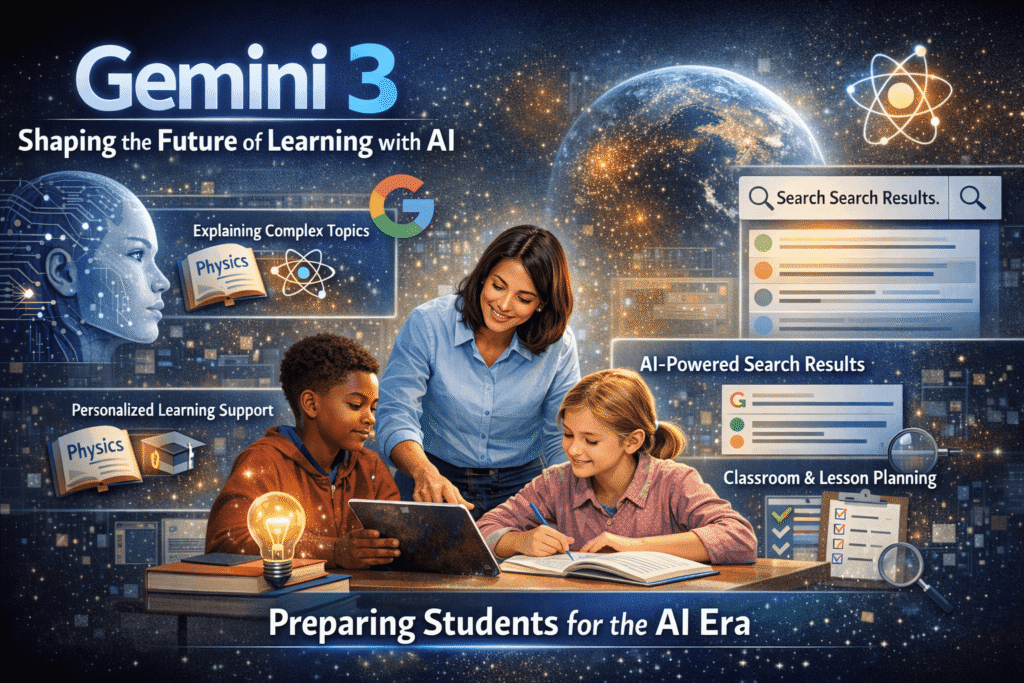
Artificial Intelligence (AI) is no longer a futuristic concept — it is a living part of modern education. From helping students summarize long texts to generating creative ideas, AI tools have become valuable study companions.
Now, Google’s new AI model, Gemini 3, is pushing those capabilities even further.
Many educators are asking: What exactly makes Gemini 3 different, and how can it support teaching and learning?
Let’s break it down.
What Is Gemini 3?
Gemini 3 is the third generation of Google’s flagship AI system. It powers both the Gemini chatbot (similar to ChatGPT) and AI features in Google Search.
This means millions of learners and teachers will interact with it — often without realizing — whenever they use Google’s new AI-powered results.
What makes Gemini 3 stand out is its strong reasoning ability and context awareness.
Unlike earlier AI models that simply looked for keywords, Gemini 3 can understand intent — it tries to figure out what you actually mean when you ask a question.
For example, if a student searches “how to prepare for my biology practical,” Gemini 3 doesn’t just list websites. It summarizes steps, explains key terms, and may even suggest a simple experiment outline.
In essence, it’s built to think more like a human tutor than a search engine.
Gemini 3 vs. ChatGPT 5.1: A Comparison of Learning Value
Google and OpenAI have been in close competition, and both Gemini 3 and ChatGPT 5.1 represent top-tier AI systems. However, early comparisons show that Gemini 3 performs especially well when clarity and comprehension matter most.
In independent tests, Gemini 3 provided more readable and structured explanations than ChatGPT when answering science and history questions.
For instance, when asked about antimatter and Paul Dirac’s role in its discovery, Gemini 3 delivered a concise, easy-to-follow definition that balanced accuracy with simplicity — ideal for classroom use.
ChatGPT’s answer, though detailed, was more technical. This shows that Gemini 3’s communication style might be better suited for students, particularly at the secondary and undergraduate levels.
Educational Benefits of Gemini 3
he arrival of Gemini 3 introduces new possibilities for both students and educators. Here are key ways it can improve learning:
a. Improved Understanding of Complex Topics
Gemini 3 is skilled at breaking down complicated subjects into smaller, digestible explanations. A history teacher, for example, could use it to help students analyze the causes of World War I with simplified summaries and timelines.
b. Stronger Integration with Google Search
Because Gemini 3 is built into Google Search, students are likely to encounter its AI summaries even during normal browsing. This can make independent research faster and more informative, helping learners see key points without getting lost in unnecessary web pages.
c. Support for Personalized Learning
Every learner has a different pace. Gemini 3 can adjust explanations based on how questions are asked.
A student struggling with fractions, for instance, could request simpler examples or step-by-step guides, while another could ask for advanced problem-solving exercises.
d. A Tool for Teachers’ Lesson Preparation
Educators can use Gemini 3 to generate lesson outlines, quizzes, or classroom discussion prompts. It can also summarize journal articles or research papers, saving teachers valuable preparation time.
The Challenges and Responsibilities
While Gemini 3 opens exciting opportunities, it also raises important questions about academic integrity and critical thinking.
AI tools can sometimes generate convincing but inaccurate information. Teachers must therefore guide students on how to verify facts and cite sources properly.
There’s also the ongoing concern about AI-assisted cheating. Gemini 3 doesn’t make it easier to cheat than previous models, but as AI tools become more capable, schools will need clear policies on how they should (and shouldn’t) be used.
The key is not to ban AI — but to teach digital literacy, helping students understand how to use these systems responsibly.
Preparing Classrooms for the AI Era
AI isn’t replacing teachers — it’s changing their role. In the next few years, educators will act more like mentors and guides, helping students use AI to explore ideas and think critically rather than memorize answers.
Here’s how schools and teachers can adapt:
- Introduce AI literacy as part of digital education.
- Train teachers to use tools like Gemini 3 in lesson planning and assessments.
- Encourage inquiry-based learning, where students ask questions and use AI for exploration.
- Use AI as feedback tools, not grading tools — helping learners reflect on their work.
Conclusion: A Smarter Way to Learn
Google’s Gemini 3 is not just another AI release — it’s a sign of how education is evolving.
Its conversational tone, clear explanations, and integration into everyday tools like Google Search make it a powerful companion for learning.
Educators who embrace it thoughtfully will find new ways to engage students, personalize learning, and save time — while teaching the critical thinking skills that technology alone can’t replace.
AI isn’t the future of learning; it’s the present. And with tools like Gemini 3, it’s becoming more accessible, interactive, and intelligent than ever.