
Lenovo’s Impact: Bringing Vision Back to CES
Walking out of the Las Vegas Sphere after Lenovo’s Tech World event at CES last Tuesday felt like stepping into two different worlds. Inside the Sphere, Lenovo presented a clear, immersive vision of what the next five years of the AI era will look like. Outside, on the main CES show floor, much of the tech industry still felt stuck, focused on small upgrades, slightly faster devices, and “smart” products that exist without any real connection to a bigger ecosystem.
For many years now, CES has slowly turned into a marketplace of scattered ideas. Most companies show up with products meant to sell in the next quarter, but they rarely explain where technology is truly heading. Lenovo broke that pattern. By taking over the Sphere, they did more than use the biggest screen in Las Vegas. They used it to communicate direction and purpose, something we have not seen at CES since the 1990s, when companies like Microsoft and Intel shaped the future of personal computing.
Today, Lenovo appears to be stepping into that leadership role. While many manufacturers wait for chip makers to tell them what is possible, Lenovo is actively defining how AI should work across devices, data centers, and the cloud. Instead of following trends, they are setting them and pulling the rest of the industry forward.
What stood out most was how confident and practical Lenovo’s AI story felt. Many companies talk about AI without fully understanding it or using it themselves. Lenovo showed solutions they are already deploying internally, and that difference was obvious. During the event, a talented female footballer performed to the song “Golden” from KPop Demon Hunters. The performance was impressive, but it also symbolized Lenovo’s message. This was not just a show. This was a statement of leadership. In simple terms, this is how CES should be done.
This week, we take a closer look at how Lenovo used CES to present a unified AI roadmap that connects personal devices, enterprise infrastructure, and intelligent orchestration. In a time when technology is becoming more complex, this kind of end-to-end thinking is no longer optional. It is essential.
The IBM Parallel and the Return of Holistic Leadership
Lenovo’s presentation covered an unusually wide range of innovations, from rollable concept PCs to liquid-cooled AI data centers. This broad approach brings to mind IBM during its strongest years, when it did not just sell computers but provided the hardware, software, services, and support needed to make everything work together.
Lenovo is positioning itself in a similar way for the AI era. It is no longer just a company that sells devices. It is becoming an outcome-driven technology provider. Whether it is experimental products like the Legion Pro Rollable or enterprise solutions like ThinkSystem servers, Lenovo’s message was consistent. They control the full technology stack. This allows them to deliver on their promise of “Smarter AI for All” in ways that fragmented competitors cannot.
Addressing the Data Center Energy Challenge
One of the biggest challenges facing AI today is energy consumption. Generative AI requires massive computing power, and many companies only talk about long-term sustainability goals without offering real solutions. Lenovo took a different approach.
At CES, they showcased their 6th Generation Neptune liquid-cooling technology. This is not a future idea or a concept promise. It is real hardware designed to solve today’s data center power and heat problems. Compared to traditional air-cooled systems still being promoted by many competitors, Lenovo’s solution is already several steps ahead.
In a tech industry often filled with noise, Lenovo’s CES presentation stood out because it offered clarity. Not just about products, but about where AI is going and how it can be responsibly built for everyone.
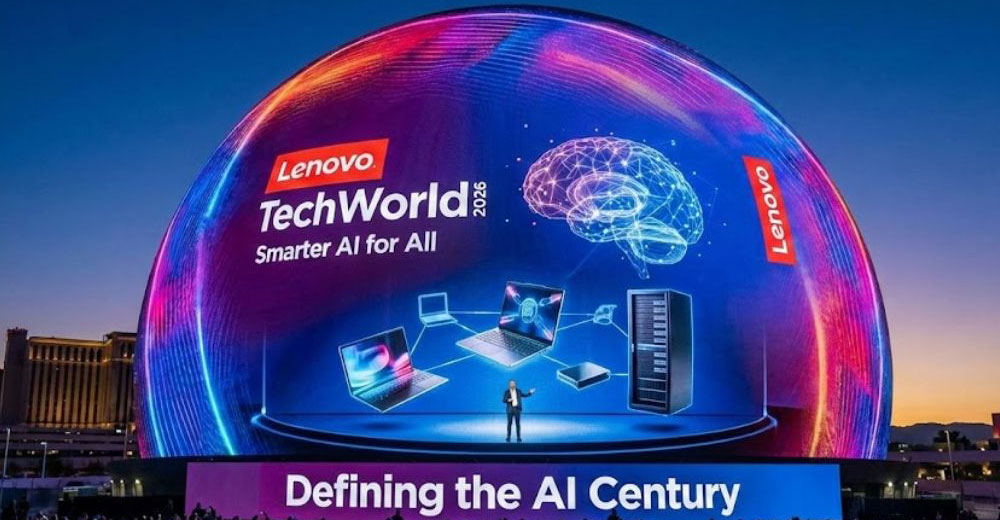
Image created with AI
As AI models grow at an exponential pace, traditional cooling systems are reaching their physical limits. Air cooling can no longer keep up with the heat generated by modern AI workloads. Lenovo’s Neptune liquid-cooling technology offers a practical way forward. It enables higher performance and greater computing density without overloading power grids.
By building this advanced cooling directly into its AI infrastructure, Lenovo is doing more than improving efficiency. It is giving data centers a realistic solution at a time when energy shortages and government regulations are becoming stricter. This is the clear difference between simply selling a product and actively solving a global infrastructure problem.
Personal Technology, Thoughtfully Reimagined
While Lenovo’s infrastructure story was impressive, the company did not overlook the personal devices that connect people to AI every day. Unlike many routine product updates seen across CES, Lenovo’s devices felt truly adaptive and user-focused.
One of the standout products was the ThinkBook Auto Twist AI PC. What began as a concept is now a real product scheduled to ship in June 2026. This laptop introduces a motorized hinge that automatically rotates the screen to face the user as they move. It changes the way people interact with laptops, especially in shared or dynamic work environments.
Lenovo also introduced a compact device with an 8.1-inch internal display that finally closes the gap between smartphones and tablets. Using Lenovo’s Smart Connect software, tasks can move smoothly between this device and a PC. It is not simply a larger screen, but a focused workspace that can fit into a pocket, making productivity more flexible than ever.
Another crowd favorite was the Legion Pro Rollable concept. While rollable displays are not new, applying the idea to a gaming laptop is a bold move. With the press of a button, the screen expands from a standard 16:9 format to an ultra-wide 24:9 display. This gives gamers and professionals the immersive experience of a desktop monitor while keeping the portability of a laptop. It shows Lenovo’s willingness to explore new form factors that others are hesitant to attempt.
Changing the Power Balance in Tech
For many years, the technology industry has followed a predictable pattern. Chipmakers design the processors, and hardware manufacturers simply build around them. Lenovo is challenging that model.
During the Tech World presentation, it became clear that Lenovo is evolving from a system integrator into a system architect. By defining how devices should behave and how users should interact with them first, Lenovo is now influencing how components are designed. Features like the Auto Twist mechanism and the Rollable display require specific power and performance considerations, which pushes suppliers to meet Lenovo’s standards. This approach closely resembles how IBM once shaped the technology ecosystem during its peak years.
Why Orchestration Matters More Than Ever
One of the most important announcements from Lenovo was its vision for AI orchestration through Lenovo Qira and the wider AI Now ecosystem. Rather than treating AI as a collection of separate tools, Lenovo is proposing a unified layer that manages how AI works across devices, networks, and the cloud.
In an era where AI is everywhere, coordination is becoming just as important as raw performance. Lenovo’s focus on orchestration suggests a future where AI feels more consistent, personal, and useful, rather than fragmented and confusing.
Image created with AI